A Brand Guideline is Now an AI Design Production System
AI and Claude are changing the way agencies, creative and marketing teams execute design at scale. The agencies worth their salt were always pivoting and in the age of Claude automations agencies need to embrace the technology with vigor. I was fortunate to have that mindset ingrained in me while working with some of the […]

AI and Claude are changing the way agencies, creative and marketing teams execute design at scale.
The agencies worth their salt were always pivoting and in the age of Claude automations agencies need to embrace the technology with vigor.
I was fortunate to have that mindset ingrained in me while working with some of the more dynamic agencies throughout my career. The best agencies never accepted the status quo, they were always pushing the envelope. They adapted to new technologies, challenged established processes, and continuously looked for better ways to deliver creative work.
Today, as a digital experience consultant (and former pixel pusher), I’m seeing another opportunity for that kind of evolution. And surprisingly, it’s not necessarily about generate ideas with AI, at least not in the framework of this topic.
It’s in how we execute them.
The Gap Between AI Experimentation and Creative Production
There’s no shortage of conversation about AI transforming the creative industry. Agencies are experimenting with AI-generated imagery, copywriting, concepts, and everything in between.
But I see a significant gap in how agencies and in-house creative departments are applying tools like Claude to the tactical production side of design and advertising.
We’re still asking talented designers to spend countless hours on repetitive production tasks that follow established guidelines from a long in the tooth brand book.
Think about the time required to produce 100 sales sheets within a strict design aesthetic, dozens of landing pages, or an entire campaign’s worth of digital advertising assets. Often, the core creative direction has already been established. The brand guidelines exist. The typography, color systems, layout principles, and messaging hierarchy have been defined.
Yet someone still needs to manually apply those rules across every execution.
Why are we continuing to treat repeatable production work as a manual creative exercise?
Let the Machines Do the Machine Work
AI is screaming to be used for versioning efficiency.
Take a well structured brand guideline or design system and imagine turning what was once a labor-intensive design production process into a repeatable, packaged Claude workflow. That’s what I’m doing now at Morse Digital Consulting. In our new workflow we are spending more time at the beginning planning and establishing every design detail, the edge-cases that need coverage, the original template and let Claude take it from there.
Instead of manually building 100 variations of a sales sheet, a team could establish a system that understands the brand’s visual language, layout constraints, content hierarchy, and production requirements.
That system could then generate variations while applying those rules consistently.
The possibilities extend well beyond sales sheets:
- Digital advertising: Produce campaign variations across sizes, messages, and placements while maintaining brand consistency.
- Landing pages: Generate structured page variations using established design systems and reusable components.
- Sales and marketing collateral: Adapt core creative into different formats for unique cohorts, audiences, products, and markets.
- Campaign localization: Scale approved creative across languages and regions without rebuilding every asset from scratch.
- Brand system execution: Turn detailed visual guidelines into repeatable production workflows rather than relying entirely on manual interpretation.
This isn’t about asking AI to invent a brand identity or make every creative decision.
It’s about building a system that knows how to execute the decisions talented people have already made.
Brand Guidelines and Design Systems Are Becoming More Important, Not Less
Here’s where I think things get interesting.
For years, brand guidelines and design systems have helped organizations maintain consistency. Conscientious brand stewards know they need to establish them. They also know most people’s eyes glaze over when they are *shown* not to stretch a logo or add a drop shadow. Their effectiveness has largely depended on people interpreting and applying them correctly.
AI changes that relationship.
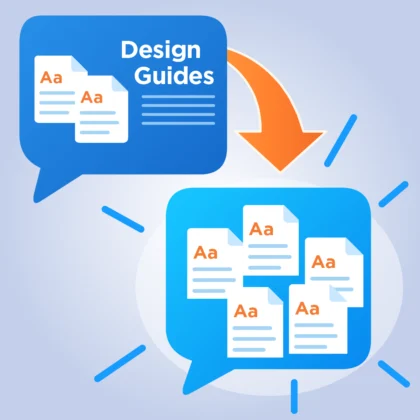
A well-crafted brand guideline can evolve from a reference document into an executable production system.
The more structured and intentional the guidelines, the greater their potential for automation.
Clearly defined typography, spacing, grids, image treatments, color usage, components, and layout rules become the foundation for repeatable production.
In other words, the quality of the underlying design system directly influences the quality of what AI can produce.
And that makes the upfront work of building thoughtful, comprehensive brand systems even more valuable.
Poorly defined guidelines will produce inconsistent outputs. Strong guidelines can become the foundation for scalable, repeatable execution.
The creative thinking doesn’t disappear. It moves further upstream, putting creatives in a more establishing role for repeatable materials.
Building the Process with Claude
This is an area I’m actively exploring and refining.
I’m working toward creating packaged Claude-driven processes that agencies and in-house design departments can use to automate traditionally manual production tasks while respecting the strict application of established brand standards.
The idea is straightforward: start with a strong brand system, translate its rules into a structured process, and create a repeatable workflow for producing consistent design assets at scale.
Getting there takes more than uploading a PDF and asking AI to make something that looks similar.
It requires defining which elements are fixed, which can vary, how content should behave, how layouts adapt, and where human review is necessary. The process is repeatable, and capable of producing assets that are genuinely useful in production in their native apps like InDesign and Illustrator where the files are editable.
The opportunity for productivity gains is substantial, and if you are a brand consultant, this value can be passed on to your clients.
The end goal isn’t to eliminate designers from production. It’s to eliminate unnecessary production work as possible through repeatitive automation.
More Time for the Ideas That Matter
The real value of this shift isn’t simply producing more assets faster.
It’s the opportunity cost clawed back. Less time resizing layouts, swapping headlines, adjusting typography, and recreating variations means more time for strategy, storytelling, experimentation, and developing creative ideas that resonate with people.
Agencies and in house teams have always needed to balance creative ambition with production realities. Claude provides an opportunity to rethink that balance.
The teams that figure out how to operationalize their design systems won’t just gain efficiencies. They’ll create more room for the kind of creative thinking that differentiates great agencies from everyone else. And that brings me back to something I learned early in my career: the best agencies are always evolving.
The next evolution isn’t necessarily about AI being more creative.
It’s about building smarter systems so that people can be.
Let the machines do the machine work.
Let the creatives do the creative work.