Lean Design Sprint
A condensed design thinking workshop that compresses the five-day Design Sprint into a single focused session. Designed for teams that need to move through Empathize, Define, Ideate, Prototype, and Test in hours rather than days. Best used when the team has a specific design question (“should we add this feature to the friend meetup app?”) and needs cross-functional input fast without committing a full work week to a sprint.
The structure below assumes a half-day session of roughly four hours with 4 to 8 participants. It works equally well in person with a wall of sticky notes or remotely on a digital whiteboard. The lean format trades depth for speed: each phase is shorter, fewer activities run per phase, and the test is usually a single one-on-one with someone outside the room rather than a full research session.
Planning the Workshop
Most of the value of a Lean Design Sprint comes from the preparation. A session that runs on a clear agenda and the right materials moves twice as fast as one that doesn’t.
1. Set the objectives
Before anything else, write down what the workshop is trying to produce: a specific design question, a feature decision, a prototype to test. Vague objectives produce vague workshops.
2. Find space for the workshop
A room with wall space for sticky notes, a whiteboard, and enough chairs. Avoid open-plan offices where noise and drop-by distractions kill focus.
3. Draft the agenda
Keep it activity-based rather than discussion-based, and resist the urge to overfill. A useful rule of thumb: the agenda should fit on a single sheet of paper, and every block should be an action the team takes rather than a slide they watch.
4. Prepare digital materials
A visible timer or wall clock, a phone for capturing photos of the wall at each phase boundary, a small slide deck for any framing context, and a single shared digital whiteboard if the session is hybrid or remote.
5. Stock physical materials
Post-it notes (multiple colors), pens, markers, paper for storyboards, tape, and circular dot stickers for voting. Bring more than you think you need.
6. Bring snacks
Fruits, nuts, and light healthy snacks keep energy stable through a multi-hour session. Avoid a heavy lunch in the middle; it will kill the afternoon.
Conducting the Workshop
The Lean Design Sprint runs through a condensed version of the five design thinking phases plus a deliberate introduction. Total runtime is roughly four hours, depending on how much time the team spends in each phase.
1. Introduction (15 minutes)
Set the tone. Welcome participants, get explicit consent for any photos or recordings, run a short ice-breaker, and walk through the agenda. The goal is to make every participant comfortable speaking up before the real work begins.
2. Empathy Phase (20 to 30 minutes)
Pair participants and have them interview each other with open-ended questions related to the workshop topic. As they listen, ask each pair to capture observations across four buckets: what their partner is saying, doing, thinking, and feeling. This is the same four-quadrant empathy map used as a standalone exercise.
3. Define Phase (15 minutes)
Each pair reframes what they heard into a single point-of-view statement and two or three “How Might We” questions. The goal is to convert empathy data into a sharp, actionable problem statement the team can solve for.
4. Ideation Phase (30 to 45 minutes)
The team generates solutions. Make the room a safe space where stick figures and rough sketches are not just allowed but expected. Time-boxed sketching activities like Crazy Eights work well here; the point is volume and divergence, not polish. Close the phase with a quick Note & Vote to pick the strongest idea to take forward.
5. Prototype Phase (45 to 60 minutes)
Prototype the winning idea. The lean version uses storyboards (drawing what a user’s day with the product looks like, scene by scene) or role-play (literally acting out the experience for the team). Skip high-fidelity tooling; the goal is something the team can show to a test user within the next hour.
6. Test Phase (30 minutes)
Bring in someone outside the workshop and have them try the prototype cold. The team observes silently and captures what is working and what isn’t. Even one test user produces the kind of feedback that resets the team’s assumptions and gives the group a clear next step.
Roles in a Lean Design Sprint
Even a short workshop benefits from clearly assigned roles. Naming these up front saves time in the room and keeps decisions from stalling.
1. Facilitator
- Role: Owns the agenda and keeps the session moving.
- Responsibilities: Holds time, runs each phase’s instructions, captures the wall in photos at every transition, resolves disagreements quickly.
2. Decider
- Role: Makes the final call when the team is split.
- Responsibilities: Usually the product owner, project sponsor, or senior team member. The Decider doesn’t run the workshop; they break ties and own the outcome.
3. Participants
- Role: Cross-functional contributors who do the actual work of the sprint.
- Composition: 4 to 8 people including a designer, an engineer, a product person, and at least one team member close to the customer (support, sales, or research).
4. Test User
- Role: Outside party who tries the prototype at the end of the workshop.
- Responsibilities: Honest reactions and questions. Recruit a test user before the workshop starts; trying to find one at hour three of the session is the most common reason lean sprints stall.
Example Walkthrough: A Friend Meetup Group Website
To make the phases concrete, here is how a Lean Design Sprint plays out against a specific challenge: design a website that helps small groups of friends actually meet up more often. The team running the sprint includes a product designer as the facilitator, and a community moderator.
1. Introduction
The facilitator writes the design question on the wall: “How might we help a group of friends meet up more often, without the planning falling on one person?” Each participant shares the last group meetup they tried to organize, what worked, and what fell apart. The ice-breaker doubles as the first piece of empathy data.
2. Empathy
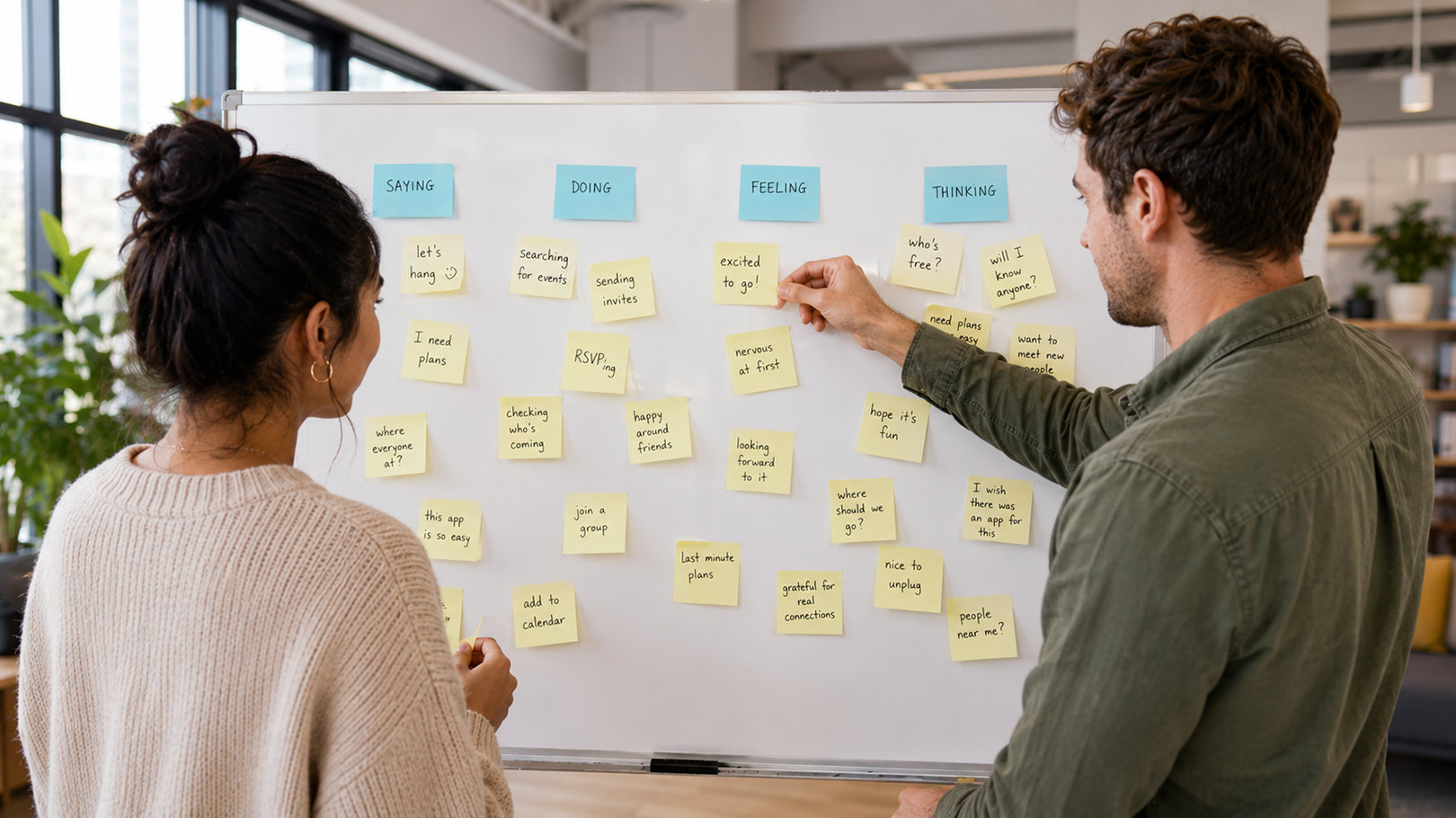
Pairs interview each other about their last attempt to organize a meetup. The facilitator asks the pairs to capture observations in the four-quadrant empathy map:
- Saying: “We should really get together.” “Anyone free next weekend?” “I’ll start a group chat.”
- Doing: Starting group chats, polling for dates, scrolling restaurants, sending reminders, eventually canceling. One person carries the load.
- Thinking: “Do they actually want to come, or are they being polite?” “If I push for a date, am I being annoying?” “Why am I always the one doing this?”
- Feeling: Anxious about leading. Frustrated when plans dissolve. Guilty when canceling. A small loneliness when nothing comes together.
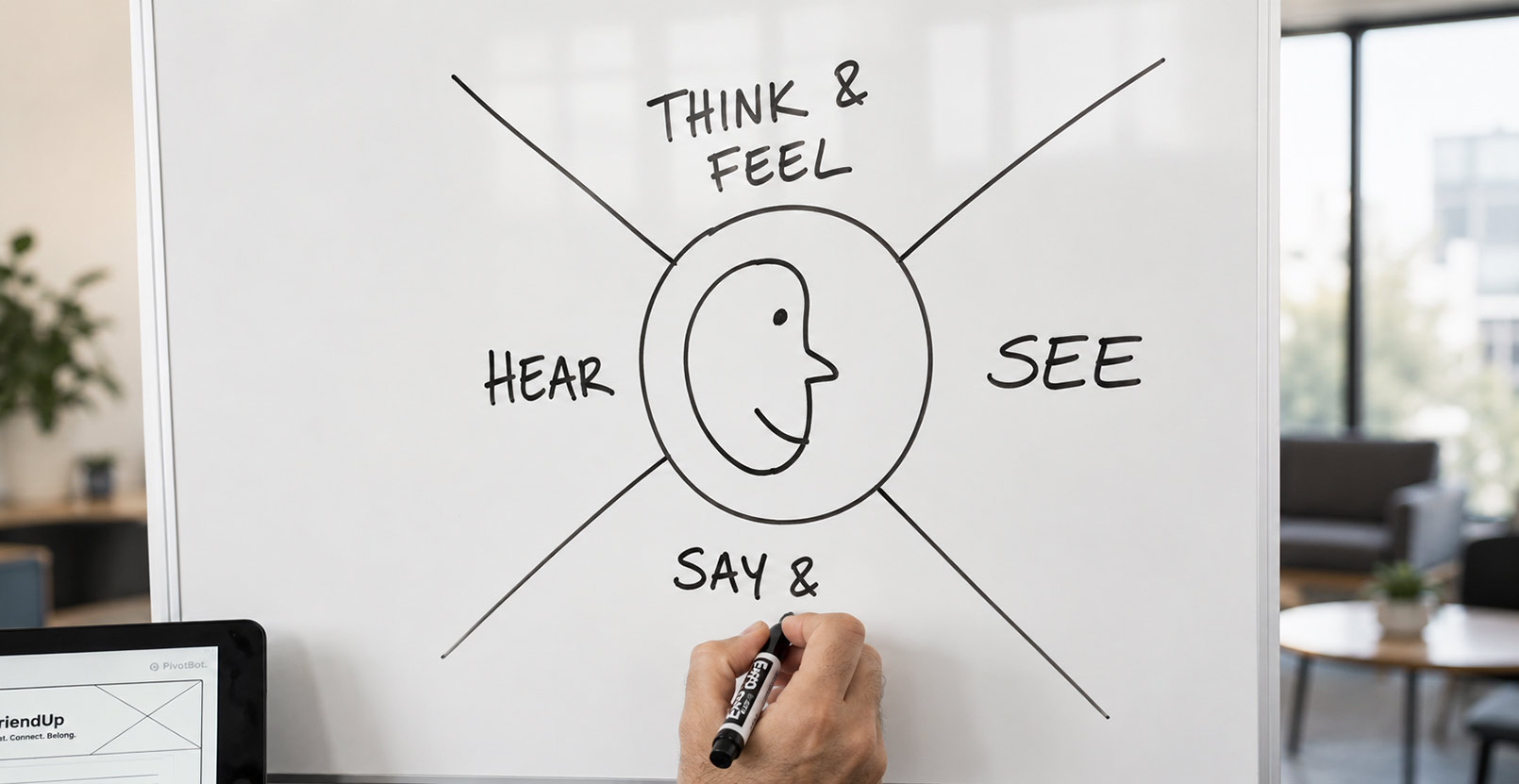
A simplified empathy map will also work for this purpose.
3. Define
The team reframes the empathy data into a single point-of-view statement: Groups of friends who want to stay close often abandon plans because one person carries the planning burden and can’t be sure the others actually want to come. They then write three “How Might We” questions on the wall:
- How might we lower the stakes of suggesting a meetup?
- How might we surface real interest from the group before planning gets serious?
- How might we distribute the planning work across the group instead of letting it land on one person?
4. Ideation
The team picks the second HMW (“surface real interest”) as the strongest and runs a round of Crazy Eights. Ideas on the wall include:
- A single-tap “I’d be down for something” button that shows up when the group hasn’t met in a while.
- A monthly “vibe check” that shows how many friends in the group are actively wanting to get together right now.
- An auto-rotating planner role so the same person isn’t always organizing.
- “Yes-if” responses (“yes if it’s not a Tuesday,” “yes if we go somewhere cheap”) instead of binary RSVP.
- A suggestion engine that pulls from the group’s past activities (“you talked about that ramen place six months ago, still want to try it?”).
A quick vote picks the single-tap interest indicator as the strongest idea to prototype.
5. Prototype
The team storyboards the experience in five panels:
- Panel 1: Sarah opens the app. A soft banner reads “Your group hasn’t met in 6 weeks. Want to see who’s itching to get together?”
- Panel 2: She taps the banner. A simple screen shows her group with a single button: “I’d be down for something this month.”
- Panel 3: She taps it. The group is notified: “Sarah’s down. Tap below if you are too.”
- Panel 4: Three other friends tap within the day. The group screen now shows “4 of 6 ready to meet.”
- Panel 5: The app suggests two dates that work for those four, and surfaces a restaurant the group had talked about earlier in their chat.
6. Test
The team brings in a friend who wasn’t in the workshop and walks her through the storyboard. Two findings emerge fast. First, she loves the single-tap “I’d be down” button because it lets her express interest without committing. Second, the auto-suggested restaurant feels presumptuous; she wants the group to choose together, not be handed a result.
The team agrees on the next iteration before they leave the room: keep the one-tap interest button, drop the auto-suggested restaurant, and replace it with a lightweight poll between two or three places the group has actually mentioned. The Lean Design Sprint produced a clear, testable direction and a list of unanswered questions to research before the next round, all within a single afternoon.
Facilitator Tips
- Keep the energy up. A flat facilitator produces a flat workshop. Stand, move, and use the timer aggressively.
- Defer minor decisions. If the team is debating something that doesn’t need to be decided to move forward, capture it on a parking-lot sticky and keep going.
- Capture everything. A photo of the wall at the end of each phase saves hours of post-workshop reconstruction and gives you the artifacts to share with stakeholders who weren’t in the room.
- Cut the next phase, not the current one. If the team needs ten more minutes on Empathy, take it from Define rather than skipping the wrap-up. Every phase matters; some just compress.
- Pre-recruit the test user. The lean sprint relies on a single outside test at the end. Confirm that person before the workshop starts and have a backup. A no-show at hour four kills the value of the session.
- End with next steps. Spend the final five minutes naming owners and dates for whatever the team decided. Otherwise, the energy of the workshop evaporates by Monday.