The Desired Goal
To translate raw user research into vivid, named characters the team can design for, instead of designing for an abstract “user” who is too easily replaced by the designer’s own assumptions.
The Tool’s Purpose:
User Personas are designed to make the people you’re building for impossible to ignore. By distilling research into fictional but data-grounded characters with names, goals, frustrations, and contexts, personas keep the team focused on the user across every product decision: who is this for, what does “Christie” actually need here, would “Joe” even open this screen. They turn a pile of interview transcripts and survey responses into a shared mental model that anyone on the team can pick up and use.
Overview:
A user persona is a fictional character built from research to represent a meaningful slice of your real user base. The technique was introduced by Alan Cooper in his 1999 book The Inmates Are Running the Asylum and has been refined over the years by Lene Nielsen, John Pruitt, Tamara Adlin, and others into four main flavors:
- Goal-directed personas focus on what the user is trying to accomplish and the workflow they prefer to get there.
- Role-based personas emphasize the user’s role inside an organization or wider context, and how that role shapes their needs.
- Engaging personas are story-rich, three-dimensional characters built to provoke real empathy. They incorporate goals, roles, emotions, backgrounds, and motivations.
- Fictional personas are assumption-based sketches without supporting research. They have early-stage uses but should not be trusted as primary guidance.
Lene Nielsen’s 10-step process for creating engaging personas covers data collection, hypothesis formation, organizational acceptance, naming a final count, writing rich descriptions, generating scenarios, disseminating the personas, and revisiting them as the product and user base evolve. A persona should include hard facts (age, role, location), interests and values, technology habits, a typical day, and future goals: enough detail to make the character feel real, but tied at every point to what the research actually showed.
Benefits:
- Forces the team to design for someone specific rather than for an averaged-out “user” who serves nobody.
- Surfaces and aligns team assumptions about who the customer actually is.
- Gives every product debate a shared touchstone: “would this work for Christie?”
- Reduces the risk of self-referential design, where the team designs for themselves without realizing it.
- Carries forward across the entire design process, usable in ideation, prototyping, testing, and stakeholder communication.
Personas were popularized by Alan Cooper in The Inmates Are Running the Asylum (1999) and have been developed further by researchers including Lene Nielsen, John Pruitt, and Tamara Adlin. The technique sits at the boundary of the Empathize and Define phases of Design Thinking: built from Empathize research, used to anchor everything that follows.
Use Case Example:
Example: A community bank is redesigning its mobile app and the product team is split on what to prioritize. The research lead synthesizes 14 customer interviews into three engaging personas. “Christie” is a 27-year-old urban renter who manages her finances entirely on her phone and expects instant transfers. “Robert” is a 62-year-old small-business owner who still drops by the branch every week but uses the app to check account balances between visits. “Maria” is a 41-year-old parent who opens the app primarily for one task, paying her kids’ weekly allowances. Each persona gets a one-page profile with a photo, hard facts, a typical day, and current frustrations with the existing app. In the next product review, the debate over whether to add a budgeting feature dissolves in five minutes. Christie needs it, Robert won’t touch it, and Maria is interested only if it’s tied directly to her allowance flow. The team agrees to ship the feature with Christie as the primary user, Maria as secondary, and a clean “skip” path for Robert. The personas didn’t make the decision on their own, but they made it possible to have the conversation on shared ground instead of opinion.
Template
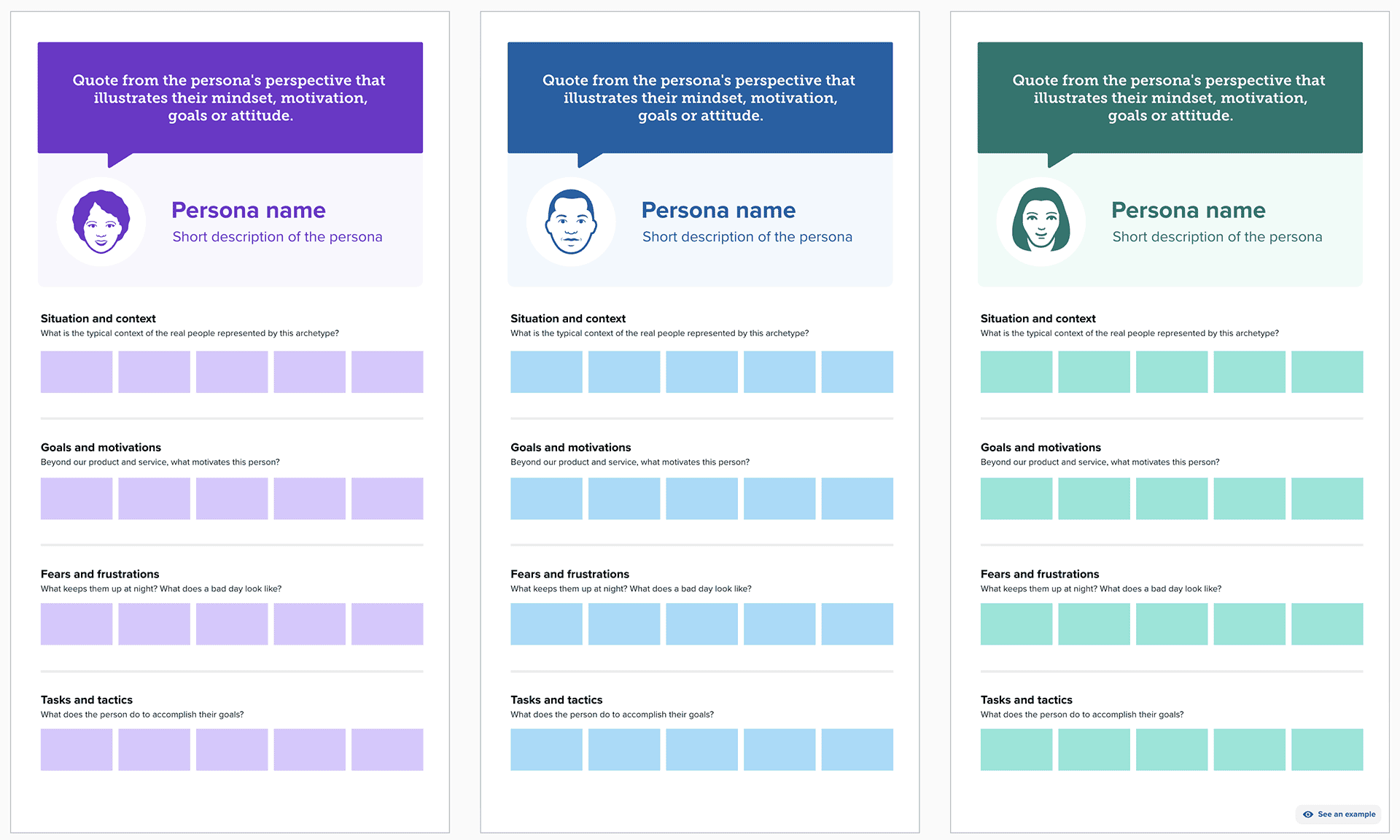
Use this User Persona template available at Mural’s website