Design Innovation Through Co-Working Strategies
Design thinking is often presented as a collection of workshops, research methods, sticky notes, and diagrams, the real value is much simpler… it helps a team hold itself accountable for the value it intends to deliver. It provides a consistent way to approach problems, determine what needs to be understood, and make decisions together. The […]

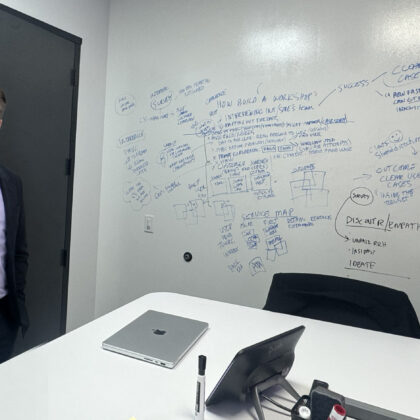
Design thinking is often presented as a collection of workshops, research methods, sticky notes, and diagrams, the real value is much simpler… it helps a team hold itself accountable for the value it intends to deliver.
It provides a consistent way to approach problems, determine what needs to be understood, and make decisions together. The goal is not to perform a design process because a consultant says that’s what the biggest, trendiest organizations are doing. The goal is to reduce the risk of solving the wrong problem.
Understanding the Problem Before Solving It
The hardest part of design is not developing a solution, it is understanding what the problem actually is.
Teams are often asked to improve a website, create a new product, redesign a service, or add a requested feature. These jobs are frequently based on assumptions about what users need and usually driven by what the business thinks it should build to increase revenue.
Before jumping into execution, a team needs to ask:
- What outcome are we trying to create?
- Who are we creating it for?
- What are they trying to accomplish?
- What is preventing us from accomplishing it today?
- How will we know that the solution created meaningful value?
This is where Jobs to Be Done thinking becomes especially useful. Instead of focusing only on the requested feature or deliverable, the team examines the progress someone is trying to make. The request may be for a new tool, but the underlying need is having greater confidence, less confusion, faster access to information, or an easier way to complete a task.
Design thinking helps teams separate the stated request from the actual job that needs to be done.
Determining the Right Questions
Good design does not begin with slick solutions that the top brass approves. It begins with better questions.
Research and data are important, but neither produces insight automatically. Collecting large amounts of information does not guarantee that a team will understand what to do next. The quality of the outcome depends heavily on whether the team understands what it needed to learn. That means determining the right questions before choosing a research method, reviewing analytics, or developing a solution.
It is not “just data.” It is not “just research.” It’s the deliberate process of deciding which unknowns matter, which assumptions need to be challenged, and which evidence could meaningfully influence a decision. If a team fails to collect the right information, even an elegant solution may be built on an incomplete understanding of the problem.
Bringing the Best Out of Collaborators
Design thinking works as a co-working strategy rather than an activity performed by a designer in isolation.
Designers may facilitate the process. It’s the valuable knowledge and insights that is often distributed throughout an organization and in need to mining. Product leaders understand business priorities. Sales teams hear customer objections. Support teams see recurring frustrations. Engineers understand technical constraints. Subject matter experts recognize details that may otherwise be overlooked.
Extended live collaboration sessions allow these perspectives to be surfaced, compared, and organized into a more complete understanding of the problem. The purpose is to escalate diverse ideas, and to transform individual observations into shared insight.
When collaboration is structured well, participants can see how their knowledge relates to others in the room. Assumptions become visible. Contradictions can be discussed. Priorities can be negotiated. Decisions become the result of collective reasoning rather than the preferences of the most influential person in the room.
Moving From Ambiguity to Certainty
Challenging product and marketing design projects begin with ambiguity.
The audience may not be fully understood. Business requirements may conflict. Stakeholders may define success differently. The organization may already have a preferred solution without having clearly established the problem. This is one of the challenges design thinking needs to overcome. Design thinking provides the steps needed to move from this ambiguous starting point toward greater certainty.
It is a necessary simplification framework, a shared mental model that helps a team understand where it is, what it needs to learn, and what decision it needs to make next.
A typical progression might include:
- Establishing the desired business and user outcomes
- Identifying assumptions and unanswered questions
- Gathering relevant evidence
- Defining the problem more precisely
- Exploring multiple possible solutions
- Testing the strongest ideas
- Using what was learned to guide implementation
The process does not remove uncertainty altogether. Instead, it gives the team a disciplined way to reduce uncertainty before making expensive decisions.
Preventing Preference Driven Design
Without a shared framework, participants tend to approach decisions according to their own experiences, incentives, and personal preferences. This is why a skilled DT facilitator is important.
One stakeholder may prioritize visual impact, another may focus on technical efficiency. Someone else may advocate for a feature because a competitor has it. A senior leader may favor a solution simply because it feels familiar.
None of these perspectives is automatically wrong, but they should not independently determine the outcome.
A design thinking framework creates a common basis for evaluating ideas. I is not a path of ask who likes what the most.
The team can ask:
- Which option addresses the defined user need?
- Which option supports the intended business outcome?
- What evidence supports this direction?
- What assumptions are we making?
- What would we need to test before proceeding?
The team can use dot voting to sort out which ideas prevail.
This changes the conversation from preference to purpose.
When Process Work Fails
The problem with design thinking is rarely the existence of a process. The problem is doing work that does not influence anything at the end.
Teams may conduct interviews, create personas, map customer journeys, or hold workshops without connecting those activities to real decisions. Research findings are documented but not referenced. Workshop outputs are presented but not used. The process becomes a performance of collaboration rather than a mechanism for producing clarity.
An interview should help answer a specific question. A workshop should help resolve a particular uncertainty. A user journey map should reveal an opportunity or guide prioritization. A prototype should test an assumption before the team commits to building it.
The value of a design method is not measured by whether it was completed. It is measured by whether it changed the team’s understanding or influenced what the team decided to do.
Accountability Through Shared Understanding
Ultimately, design thinking is about how well we understand what we are being asked to do. It helps teams clarify the outcomes they are responsible for creating, understand the user groups they intend to serve, and determine whether a proposed solution is likely to deliver meaningful value.
The resource intensive, co-working makes that understanding stronger by bringing different perspectives into the same process. The framework keeps those perspectives connected to a common objective. Research reduces uncertainty. Testing challenges assumptions. Shared decision-making creates accountability.
Business innovation does not come from following a rigid sequence of activities, it comes from creating the conditions in which a group can ask better questions, develop a shared understanding, and make more informed choices.
That is the real purpose of design thinking is not simply to generate ideas, but to help people move together from ambiguity toward a solution they have a reason to believe in.